
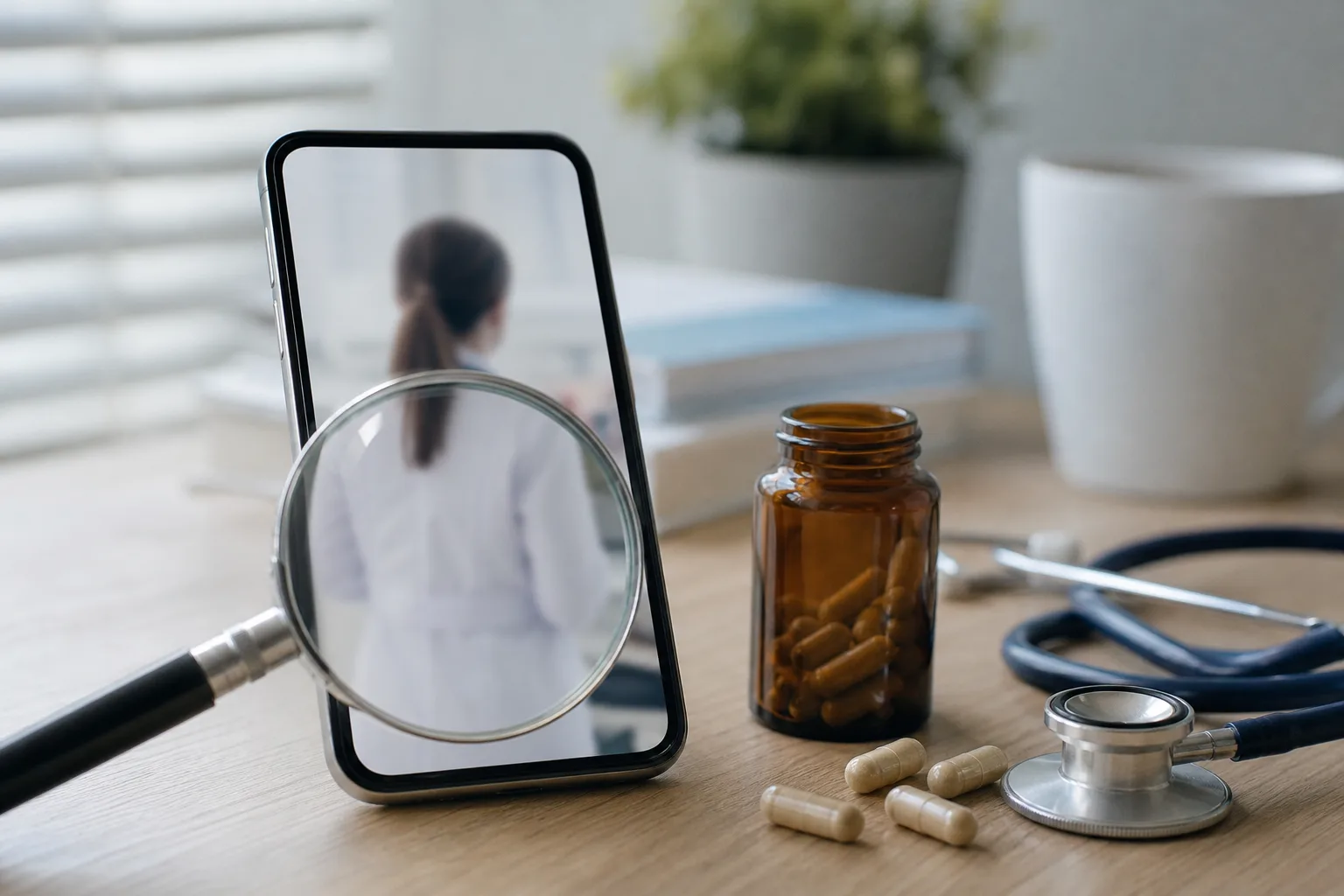
Scroll through a social feed for long enough and you will meet him: a reassuring doctor in a white coat, explaining that one capsule fixed what years of prescriptions could not. Sometimes the doctor is a real, well-known physician whose face and voice have been cloned. Sometimes the "doctor" never existed at all. Either way, the endorsement is doing the selling.
For clinic managers, HR and compliance teams and anyone building health-tech products, this is more than a consumer-protection story. It is a live example of what happens when a professional title can be claimed by anyone and checked by almost no one.
What a fake doctor endorsement looks like
The pattern is familiar. A video or article features a person presented as a physician, with a name, a title and often a clinical backdrop, who vouches for a supplement or a "breakthrough" product. The claims tend to target long-term conditions where people are tired of slow progress: blood pressure, blood sugar, joint pain, weight.
Many of these promotions are not plain banner ads. They travel through native placements, such as in-feed units and content-recommendation widgets that look like editorial headlines, and land on an advertorial styled as a news story or a doctor's interview before sending the reader to a checkout. The knowledge base at AffHouse, a trade publication covering affiliate and performance marketing, has a clear explainer on how native advertising works, from recommendation widgets and native ad networks to the presell pages affiliates use and the FTC's labelling rules.
That middle step matters. The fake doctor often lives on the presell page rather than in the ad itself, so judging only the small unit in the feed misses most of the story.
Real cases: trusted TV doctors, deepfaked
In July 2024 The BMJ published an investigation by journalist Chris Stokel-Walker into deepfaked videos of well-known British TV doctors. Hilary Jones, Michael Mosley and Rangan Chatterjee were among those whose likenesses were used to promote products claiming to fix high blood pressure and diabetes, as well as hemp gummies.
Many of the videos found by John Cormack, a retired doctor who worked with the BMJ, were on Facebook and Instagram. Meta said it would investigate the examples and that it does not permit content that intentionally deceives or seeks to defraud others. Jones told the journal that he employs a social media specialist to find such videos and request takedowns, and that removed videos tend to reappear under a different name.
The same piece cited research suggesting that up to half of people shown deepfakes of scientific speakers could not tell them apart from genuine videos. Looking carefully is not a reliable defence on its own.
What regulators and platforms have done
In the US, the Federal Trade Commission announced its Trade Regulation Rule on the Use of Consumer Reviews and Testimonials in August 2024, and it took effect on October 21, 2024. It makes it unlawful for a business to create or sell consumer or celebrity testimonials that misrepresent whether the testimonialist exists, whether they actually used the product, or what their experience was. It also bars businesses from spreading such testimonials about their own products when they knew or should have known they were false. The FTC has said AI-generated fakes are covered, and the rule lets it seek civil penalties against knowing violators.
Health claims get extra scrutiny. The FTC's Health Products Compliance Guidance, issued in December 2022 to replace its 1998 dietary supplement guide, says an expert endorser should have appropriate qualifications and should actually have examined or tested the product. One of its examples describes an ad that presented a person with a doctorate in psychology, not licensed to practise medicine, as a "Doctor" and a leading clinician, and concludes that her qualifications were overstated. The guidance also makes clear that an honest testimonial is not enough: the advertiser still needs scientific evidence that the product works.
In the UK, the CAP Code enforced by the Advertising Standards Authority requires objective health claims to be backed by evidence (rule 12.1), treats health professionals as suitably qualified only if they can provide suitable credentials (rule 12.2), and bans the use of health professionals or celebrities to endorse medicines (rule 12.18).
Platforms have moved too. In October 2024 Meta began testing facial recognition against so-called celeb-bait scam ads, comparing faces in flagged ads with the public figure's Facebook and Instagram profile pictures; the test did not initially cover the UK or the EU. That approach can help a famous doctor. It does nothing for an invented one, because there is no real profile to match against.
How to check whether a "doctor" is real
You cannot judge a product from an ad, and this is not the place for medical advice. You can, however, check the messenger. A few steps catch most fakes:
- Get a full name and a place of practice. An ad that offers only a first name, or a title with no surname, has already told you something.
- Search the official register. In the US, DocInfo, run by the Federation of State Medical Boards, is free and shows licence history and state board disciplinary actions; each state board also has its own lookup. In the UK, the General Medical Council's online register shows whether a doctor is registered and holds a licence to practise.
- Match the field to the claim. As the FTC example shows, a doctorate in an unrelated subject does not make someone a medical expert.
- Look for the endorsement on the doctor's own channels. A genuine endorsement can usually be traced to the doctor's own website, clinic or verified accounts. One that appears only inside an ad deserves suspicion.
- Report it. The BMJ piece recommends using the platform's reporting tools and also reporting the account that shared the post.
The weakness of this list is obvious: every step is manual, and most people scrolling past an ad will never do any of it.
Why verifiable credentials matter
The root problem is that a professional claim in an ad, such as "Dr X, cardiologist", is just text and pixels. Anyone can type it, and generative tools now make convincing faces and voices just as cheap. A registry lookup works, but only after someone thinks to do it.
Verifiable credentials flip the default. An issuer such as a licensing body, hospital or university digitally signs a statement about a person, and anyone can check by software that it came from that issuer and has not been altered. The W3C published the Verifiable Credentials Data Model v2.0 as a Recommendation in May 2025, which gives platforms, regulators and clinics a shared format instead of one-off integrations.
If ad review asked for a signed professional credential whenever a creative says "doctor", fake endorsements would not disappear, but invented physicians would become much harder to pass off.
What clinics and compliance teams can do now
Start with your own house. If your marketing features clinicians, keep a record of their registration and written consent. Set up simple monitoring for your staff's names and faces in ads, and agree in advance who files takedown requests.
The same logic applies to the documents your teams accept every day, from sick notes to fitness-to-work certificates. A paper or PDF certificate can be faked as easily as a white coat in a video. Moving to certificates that can be verified at the source, rather than trusted on sight, is the problem MediCert works on, and the reason we treat security and compliance as part of the product rather than an add-on.
The fake doctor in your feed is a reminder that credentials only protect people when they can be checked quickly. The tools to make that routine already exist.
Sources
- The BMJ — Deepfakes and doctors: How people are being fooled by social media scams (2024)
- FTC — Federal Trade Commission announces final rule banning fake reviews and testimonials
- Federal Register — Trade Regulation Rule on the Use of Consumer Reviews and Testimonials (89 FR 68034)
- FTC — Health Products Compliance Guidance
- ASA / CAP — CAP Code section 12: Medicines, medical devices, health-related products and beauty products
Issue medical certificates anyone can verify in seconds.
Learn about MediCert